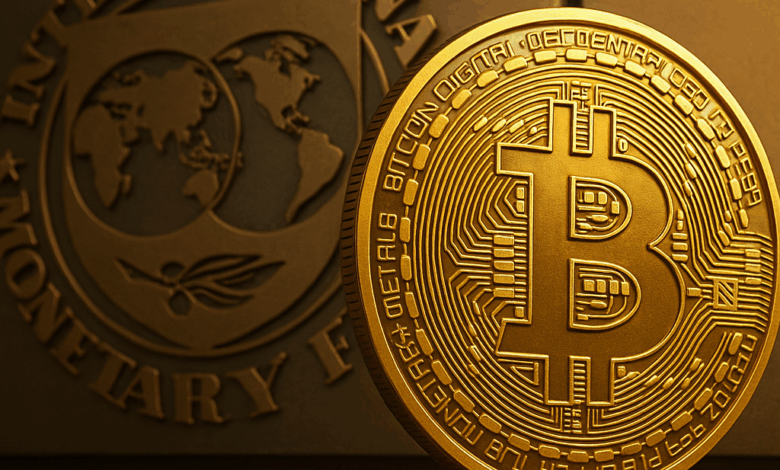
The IMF’s New Stand on Bitcoin: A Game-Changer for Economic Statistics
The International Monetary Fund (IMF) has made a significant shift in its approach to Bitcoin, as revealed in a recent staff blog. This step marks Bitcoin’s integration into the core economic statistics of the world, a development unveiled with the United Nations Statistical Commission’s endorsement of the revamped System of National Accounts (SNA). The IMF highlighted Bitcoin’s substantial economic influence, particularly due to its high energy consumption. However, as Bitcoin does not lead to the conventional production of goods or services, it has traditionally been excluded from the gross domestic product (GDP).
Recognizing Bitcoin as a Non-Produced Nonfinancial Asset
To bridge this measurement gap, experts have decided to categorize specific crypto assets, including Bitcoin, as ‘non-produced nonfinancial assets.’ This classification will now reflect in the national wealth metrics. It’s not a value judgment on Bitcoin but rather a move to incorporate it into governmental balance sheets, acknowledging it alongside assets like land and subsoil. For a technology once overlooked, this is a significant institutional acknowledgment, using the language familiar to central banks and treasuries.

Advertisement Banner
Bitcoin’s Integration into Economic Systems
The IMF’s public message, which resonated across Bitcoin communities, emphasized: “Bitcoin consumes as much electricity as Argentina, yet remains uncounted in GDP due to its non-traditional service or goods creation.” This statement echoes prior IMF discussions highlighting Bitcoin and AI as energy-intensive sectors that require policymakers’ attention.
In 2024, the IMF estimated that Bitcoin mining and data centers accounted for approximately 2% of the global electricity usage in 2022. Future projections, based on the International Energy Agency’s data and cited by IMF authorities, suggest this could rise to around 3.5% by 2027. The key takeaway for market stakeholders is the newfound statistical recognition: activities that are explicitly measured become part of the broader economic conversation regarding assets, flows, and external balances.
Changing External Accounts and Balance of Payments
This visibility is further enhanced in external accounts. The IMF’s updated Balance of Payments Manual (BPM7) now includes Bitcoin in cross-border statistics, treating transfers of non-liability crypto such as Bitcoin as transactions involving ‘non-produced nonfinancial assets.’ Importantly, ‘validation services’ are now recognized as services.
The manual’s draft chapters offer clear examples, illustrating how a miner or validator in one economy, compensated by a user in another, is recorded as cross-border services trade. An annex detailing changes from BPM6 specifies that validation payments are recorded as cross-border transactions in crypto assets payable to the service providers. Practically speaking, mining and staking sold to non-residents are considered exports in the services account, while cross-border Bitcoin acquisitions and disposals are recorded in the capital account. This is a significant shift for a sector often portrayed as operating ‘off the books.’
Bitcoin’s Growing Economic Impact and Recognition
Bitcoin advocates immediately highlighted the importance of this development. David Bailey noted, “This is substantial news—IMF officially integrating Bitcoin into the international development framework,” emphasizing that “trade balance, GDP, and sovereign credit quality will now consider Bitcoin’s economic impact.” The key message is clear: economic gatekeepers will now account for what was previously unseen.
For Jan Wüstenfeld, a researcher at Melanion GreenTech, the implications are as much human as they are statistical. He describes Bitcoin as “the most efficient tool for converting energy into a lifeline for those affected by IMF-imposed policies,” adding, “Bitcoin’s energy-to-lifeboat ratio is unmatched.”
Climate researcher Daniel Batten criticized the IMF’s portrayal of Bitcoin’s energy use as “FUD” (Fear, Uncertainty, and Doubt), viewing this moment as a confirmation rather than a critique: the asset has become too significant to ignore.
A Watershed Moment for Bitcoin Recognition
The Sustainable Bitcoin Protocol offered a detailed response, arguing that while some may have fixated on the term “energy-intensive,” the broader picture of formal integration is crucial. They stated, “The IMF has officially classified Bitcoin as a non-produced capital asset. Bitcoin is no longer invisible, even to the IMF. This is legitimization and macro adoption.” This perspective aligns with the BPM7 and SNA frameworks: once Bitcoin is recognized as a capital asset and its validation services are recorded as such, it integrates into balance-of-payments and national wealth statistics by design.
However, this development doesn’t imply a shift in the IMF’s cautious stance on sovereign Bitcoin policies. Instead, it indicates an update to the statistical framework while maintaining a cautious approach to associated risks. Batten’s recent research suggests that IMF influence has hindered the adoption of Bitcoin at the nation-state level.
He cites El Salvador’s agreement with the IMF, where authorities committed not to increase Bitcoin holdings at the public sector level, even as the National Bitcoin Office revealed additional purchases for a “Strategic Bitcoin Reserve.” Batten also pointed to Pakistan, where reports in early July suggested the IMF rejected a plan to offer subsidized electricity for Bitcoin mining and other energy-intensive industries. However, both Pakistan’s Power Division and the IMF denied any formal rejection.
Conclusion: A Constructive Development for Bitcoin
Despite these policy challenges, the recent standards update from July 31 is a positive step for Bitcoin. The IMF blog highlights two critical points for asset allocators: first, the classification of certain crypto assets as ‘non-produced nonfinancial assets’ brings them into national wealth measurements. Second, it signals alignment with BPM7, ensuring coherent recording of cross-border flows and validation-service revenues in both external and national accounts.
As of now, Bitcoin trades at $115,658, reflecting its ongoing journey in the global economic landscape.
Editorial Integrity in Bitcoinist’s Content
Editorial Process: At Bitcoinist, our editorial process is committed to delivering well-researched, accurate, and unbiased content. We maintain rigorous sourcing standards, and each article undergoes thorough review by our team of technology experts and experienced editors. This ensures the reliability, relevance, and value of our content for our readers.