

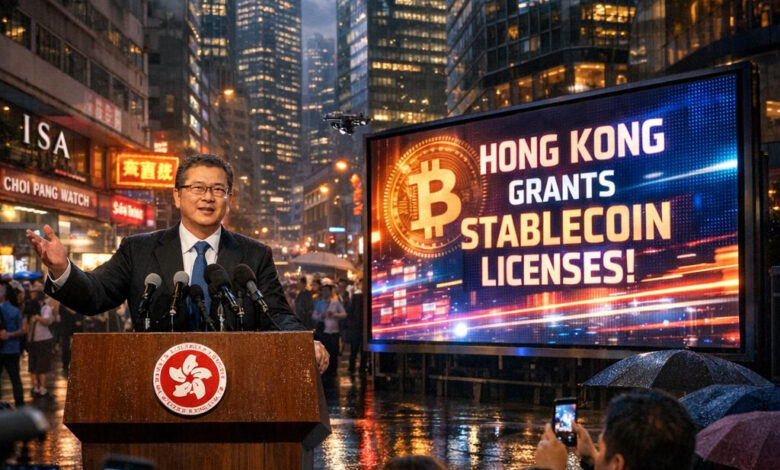
Hong Kong Advances as a Fintech Leader with Stablecoin Licensing Plans
At the prestigious World Economic Forum held in Davos, Switzerland, Hong Kong’s Financial Secretary, Paul Chan Mo-po, unveiled ambitious plans for the region to issue licenses to stablecoin providers. This initiative, set for the first quarter of the year, underscores Hong Kong’s commitment to positioning itself as a pioneering hub in financial technology.
Comprehensive Regulatory Framework in Hong Kong
During his address, Chan detailed Hong Kong’s comprehensive regulatory framework for digital assets, characterizing it as both “responsible and sustainable.” He underscored the necessity of a balanced regulatory approach that fosters the growth of both finance and technology, emphasizing their “mutually reinforcing” nature.

Advertisement Banner
Chan elaborated on the advantages of digital assets, highlighting their ability to enhance transparency, improve risk management, and streamline capital movement. He remarked, “We regard digital assets as a financial innovation we should actively embrace.” Furthermore, Chan emphasized the importance of ensuring that digital assets serve the real economy, while implementing robust safeguards to mitigate risks associated with financial stability, market integrity, and investor protection.
He reiterated the principle of “same activity, same risk, same regulation,” aimed at fostering a healthy, responsible, and sustainable environment for digital asset development. The government and regulatory bodies, Chan asserted, will serve as “market enablers,” setting a benchmark for innovation.
Imminent Stablecoin Licensing
In recent years, Hong Kong has intensified its efforts to establish itself as a fintech leader, particularly amidst global competition. Since 2023, the city has successfully issued three batches of tokenized green bonds, collectively valued at $2.1 billion. Additionally, Hong Kong has already implemented a licensing framework for virtual asset trading platforms.
Notably, the Hong Kong Monetary Authority (HKMA) launched a pilot program last November to facilitate transactions using tokenized deposits and digital assets. Chan highlighted the forthcoming licensing regime for stablecoins, indicating that the first licenses are anticipated to be issued shortly.
Reports from the HKMA reveal that by September 30, the authority had received formal stablecoin license applications from 36 institutions. This figure represents nearly half of the 77 expressions of interest recorded in August. The applicants span a diverse spectrum, including banks, technology companies, securities and asset management firms, e-commerce platforms, payment service providers, and Web3 startups.
A spokesperson for the HKMA confirmed that the authority will meticulously review all submission materials and conduct approvals in accordance with the new Stablecoin Ordinance and relevant regulatory guidelines. While the HKMA aims to announce the first batch of licensed stablecoin issuers between the first and second quarters, it has warned that the licensing process will be rigorous, with only a select number of licenses being granted initially.
Editorial Integrity and Standards
The editorial process at bitcoinist is focused on delivering meticulously researched, accurate, and unbiased content. We adhere to stringent sourcing standards, and each page undergoes thorough review by our team of top technology experts and experienced editors. This rigorous process ensures our content’s integrity, relevance, and value for our readers.
“`
This revised content is enhanced for SEO with relevant keywords, structured HTML headings, and enriched language quality to improve readability and search engine ranking.