

Debate Over XRP’s Future in the Evolving Crypto Market
The crypto community witnessed a renewed debate about XRP’s relevance following comments by Chainlink Community Liaison Zach Rynes (@ChainLinkGod). In a thought-provoking discussion, Rynes contended that the investment rationale for XRP has not evolved in tandem with the rapid changes in crypto markets and financial systems. His assertion was straightforward: the XRP Ledger is now a “ghost chain,” with its initial role as a bridge asset largely replaced by stablecoins and enhanced interoperability infrastructure.
Rethinking XRP’s Role in the Financial Landscape
Rynes specifically critiqued the longstanding retail investment thesis for XRP. He highlighted the once-popular belief that XRP would serve as the global reserve currency, facilitating transactions by acting as an intermediary (“XRP standard”). He explained, “Instead of exchanging Dollars for Euros directly, the idea was to trade USD for XRP and then XRP for EUR to supposedly enhance payment efficiency.”

Advertisement Banner
According to Rynes, supporters of XRP often redefine this vision as a more limited “bridge currency” role, a distinction he believes does not alter the fundamental argument. He emphasized that the market structure envisioned by early advocates of XRP has been realized through other means over the past decade.
The Evolution of Financial Technology
Rynes elaborated on the technological advancements that have redefined financial markets: “The XRP vision was conceived over a decade ago, before the emergence of modern 200K TPS high-throughput chains, programmable smart contracts, DeFi protocols, fiat-backed stablecoins, tokenized deposits, atomic DvP/PvP swaps, and cross-chain infrastructure.” He noted that major financial entities like Swift, DTCC, JP Morgan, and BlackRock prioritize connectivity, interoperability, privacy, compliance, and orchestration over the need for a bridge currency.
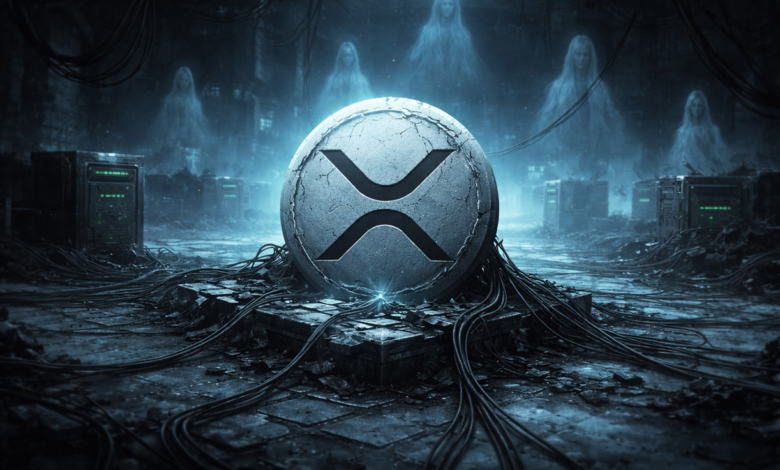
This criticism extended to the XRP Ledger’s role in tokenization and on-chain finance. Despite what he described as weak adoption metrics, Rynes observed that many XRP holders still believe XRPL will dominate the tokenized real-world assets market. He characterized XRPL as a “ghost chain” with minimal market share in tokenized real-world assets and stablecoins, arguing this undermines its potential as a primary settlement layer.
Stablecoins have emerged as the de facto winner in the bridge-asset debate. Rynes argued, “USD-backed stablecoins have become the dominant crypto-native ‘bridge currency’ for payments, trading, and finance.” He cited Hyperliquid as an example of crypto-native finance where positions across markets are effectively denominated against dollar-backed stablecoins rather than XRP.
Ripple’s Business Model Under Scrutiny
Rynes also critiqued Ripple’s business strategy, alleging that Ripple “socializes its costs to XRP holders while privatizing gains for its equity shareholders.” He claimed that XRP sales finance products whose revenues benefit Ripple rather than directly benefiting token holders. He further noted that about 90% of RLUSD’s supply resides on Ethereum and other chains, which, in his view, creates little direct demand for XRP itself.
XRP Community Fires Back
Not everyone agreed with Rynes’ perspective. XRP advocate and attorney Bill Morgan challenged the comparison between token buybacks and equity buybacks, labeling it “a false equivalence since a token is not akin to a share and lacks associated rights.” He also disputed the notion that Ripple and the XRPL should be treated as a single entity, asserting, “Ripple does not own the XRPL, which is a fully decentralized public permissionless blockchain.”
Morgan highlighted Ripple’s strategic choice in using Evernorth, an independent entity created to acquire XRP and provide institutions with regulated exposure. He argued this model was preferable to Ripple managing a reserve, potentially subject to regulatory scrutiny, especially considering the SEC’s prior focus on Ripple’s efforts to influence XRP’s value during litigation.
At the time of writing, XRP was trading at $1.4757.
Editorial Process
At bitcoinist, our editorial process is dedicated to delivering well-researched, accurate, and impartial content. We adhere to stringent sourcing standards, with every page meticulously reviewed by our team of leading technology experts and experienced editors. This rigorous process guarantees the integrity, relevance, and value of our content for our readers.