
Exploring Bybit’s Strategic Alliance with the Stockholm Open
Discover how Bybit’s recent collaboration with the Stockholm Open is redefining the landscape for high-net-worth individuals and institutional investors in Europe. This strategic move highlights the growing intersection between digital assets and elite sports, marking a significant shift in the way cryptocurrency platforms engage with sophisticated audiences.
Key Insights on Bybit’s Strategic Shift
- ➡️ Bybit’s partnership with the Stockholm Open is a strategic move aimed at engaging affluent and institutional investors across Europe.
- ➡️ The demand for integrated infrastructure solutions is growing as the gap between institutional interest and on-chain user experience widens.
- ➡️ LiquidChain is tackling liquidity fragmentation by integrating BTC, ETH, and SOL ecosystems into a unified execution layer.
- ➡️ Infrastructure projects are receiving consistent capital inflows, with initial investors focusing on utility-driven tokenomics rather than mere governance rights.

Advertisement Banner
Bybit’s Bold Move into the European Market
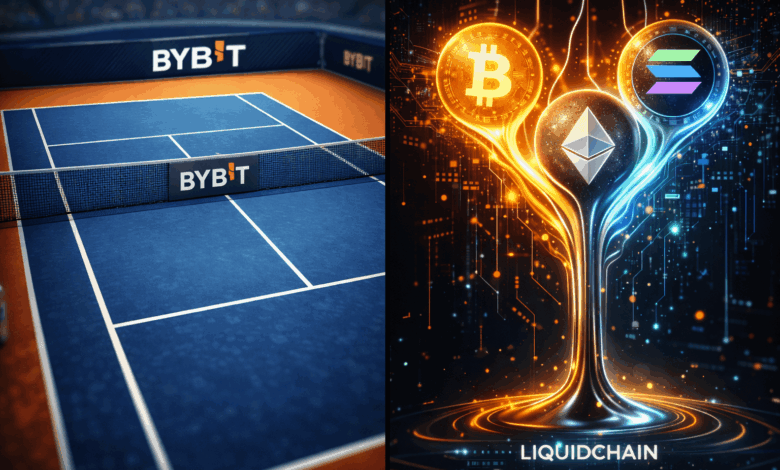
The digital asset sphere witnessed a pivotal moment as Bybit unveiled its title sponsorship with the Stockholm Open, rebranding it to the ‘BNP Paribas Nordic Open’. This collaboration goes beyond mere branding; it represents a calculated approach to engage with a high-net-worth audience. By partnering with the oldest ATP indoor tournament, Bybit aims to captivate a European institutional demographic that has traditionally been cautious about the volatile crypto market.
The Evolution of Sports Sponsorships in Crypto
Sports sponsorships have evolved from being mere publicity stunts to strategic initiatives aimed at enhancing credibility. Similar to how Crypto.com sought to normalize digital assets for the general public through arena naming rights, Bybit’s involvement with tennis targets a sophisticated, capital-rich investor base. Data indicates that exchanges are reorienting marketing budgets towards building trust, anticipating a market transition from retail speculators to long-term holders.
Challenges in On-Chain Infrastructure
However, attracting institutional capital to the blockchain reveals significant challenges in the current market structure, notably infrastructure fragmentation. While exchanges facilitate easier entry, the actual on-chain experience remains hindered by complex bridging processes, wrapped asset risks, and liquidity scattered across networks like Ethereum and Solana. As traditional finance (TradFi) looks to transition, the infrastructure required is still under construction.
LiquidChain’s Role in Bridging the Gap
The gap between marketing promises and technical reality has shifted the focus of savvy investors towards Layer 3 (L3) solutions capable of unifying these ecosystems. Among the protocols addressing this issue is LiquidChain ($LIQUID), a cross-chain liquidity layer that is quietly amassing capital in its early presale phases.
Integrating Bitcoin, Ethereum, and Solana
The current DeFi environment segregates users and developers into silos. Developers on Solana face challenges accessing Ethereum liquidity without cumbersome bridges or wrapped tokens, often susceptible to major hacks. LiquidChain ($LIQUID) seeks to address this with its Layer 3 infrastructure, merging Bitcoin, Ethereum, and Solana liquidity into a single operational framework.
This integration is crucial. Many ‘interoperability’ protocols merely facilitate communication between chains, while LiquidChain functions as a Cross-Chain Virtual Machine (VM), enabling ‘Single-Step Execution’. Practically, a user could stake assets on Ethereum and obtain a loan on Solana in one transaction, bypassing manual fund bridging.
The ‘Deploy-Once’ Advantage for Developers
For developers, the ‘Deploy-Once’ architecture is enticing, allowing code to simultaneously tap into the user bases of the three largest blockchains. However, the complexity of executing verifiable settlements across non-EVM (Bitcoin) and high-speed (Solana) chains presents a significant technical challenge. Yet, the need for a Unified Liquidity Layer is undeniable.
As liquidity fragmentation diminishes capital efficiency, protocols that abstract away underlying chain complexities are well-positioned to capture the next wave of DeFi volume.
Capital Flowing into LiquidChain’s Presale
Amidst broader market reactions to macroeconomic signals and exchange partnerships, on-chain metrics reveal a shift towards infrastructure investments. LiquidChain has raised $533K in its ongoing presale, with tokens priced at $0.0136. This amount, while modest compared to the massive ICOs of 2017, reflects steady accumulation during a period characterized by risk-averse capital.
The presale data indicates a strategic positioning ahead of the protocol’s mainnet deployment. Investors are betting on the narrative that the native $LIQUID token will serve as ‘transaction fuel’ essential for cross-chain operations and liquidity staking.
The Value Proposition of Infrastructure Tokens
Unlike governance-only tokens, infrastructure tokens derive value from network usage volume. If LiquidChain succeeds in capturing even a fraction of the cross-chain arbitrage and settlement market, the utility demand for the token could theoretically decouple from pure speculation.
What’s often overlooked is the timing. With Bitcoin’s ecosystem expanding via L2s and Solana’s dominance in retail memes, the necessity for a connecting layer is at its peak. The presale data signifies a portion of the market hedging against the “winner takes all” chain thesis, opting to invest in the infrastructure that connects them.
This article is not financial advice. Cryptocurrency investments, including presales and Layer 3 protocols, carry high risks, including total capital loss. Always conduct independent due diligence before investing.
Our Editorial Commitment
At bitcoinist, our editorial process is dedicated to delivering thoroughly researched, accurate, and unbiased content. We adhere to strict sourcing standards, ensuring each piece undergoes rigorous review by our team of top technology experts and seasoned editors. This process guarantees the integrity, relevance, and value of our content for our readers.