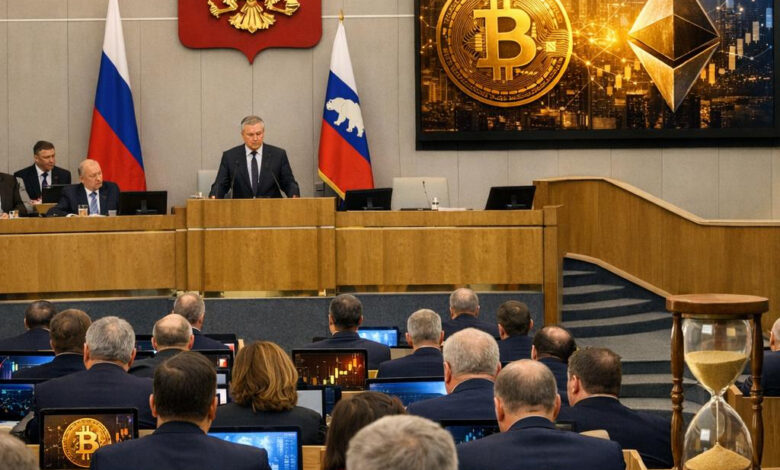
Russia Moves Forward with Cryptocurrency Regulation Framework
In a significant step towards cryptocurrency regulation, Russia is advancing towards establishing a comprehensive legal framework for digital assets. The collaboration between lawmakers and regulators is geared towards defining the treatment of cryptocurrencies within the nation.
Upcoming Legislative Developments in Russia
According to Anatoly Aksakov, who chairs the State Duma Committee on the Financial Market, a relevant set of legislation is projected to be finalized by the end of June this year. Starting on July 1, 2027, the new regulations aim to impose accountability on intermediaries engaging in illegal activities in the crypto market, with penalties mirroring those for unauthorized banking operations.

Advertisement Banner
Central Bank’s Role in Crypto Regulation
The Central Bank of Russia has been laying the groundwork for these regulatory changes over several months. Reports from local media highlight that the Central Bank submitted its proposals to the government in December of last year. The proposals delineate digital currencies and stablecoins as currency values that can be traded but prohibit their use as a payment method within Russia.
Under this framework, retail investors with limited experience would be restricted to purchasing only highly liquid cryptocurrencies, contingent upon passing a suitability test. Bitcoin (BTC) and Ethereum (ETH) are likely candidates, while Solana (SOL) and Toncoin (TON) may also be considered due to their popularity in the region.
Regulations for Qualified Investors
Qualified investors will have additional requirements to meet. They must undergo mandatory testing to prove their understanding of the risks associated with cryptocurrency transactions. Upon approval, they can acquire digital assets without volume restrictions, except for anonymous cryptocurrencies, which are banned. Cryptocurrencies like Monero (XMR), Zcash (ZEC), and Dash (DASH), which obscure transaction details, will not be allowed as they fail to meet anti-money laundering standards.
Legislative Progress and Future Implications
The legislative process is already in motion, with Aksakov stating that the State Duma is working towards formalizing these changes into law. The initial focus includes creating structured rules for the issuance, mining, and circulation of cryptocurrencies, while reiterating the prohibition of their use as a form of domestic payment.
The legislative bill may be presented for its first reading as early as next month. This law is also anticipated to introduce a range of penalties—administrative, financial, and potentially criminal—for illegal activities within the digital asset market.
This regulatory effort follows a crucial legal milestone earlier this year. On January 20, 2026, Russia’s Constitutional Court delivered a verdict that addressed a long-standing legal ambiguity impacting numerous crypto holders.
Editorial Integrity and Commitment
The editorial process at bitcoinist is focused on providing well-researched, accurate, and impartial content. We adhere to stringent sourcing standards, and each article undergoes thorough review by our team of leading technology experts and experienced editors. This ensures that the content we deliver maintains its integrity, relevance, and value to our readers.
“`