

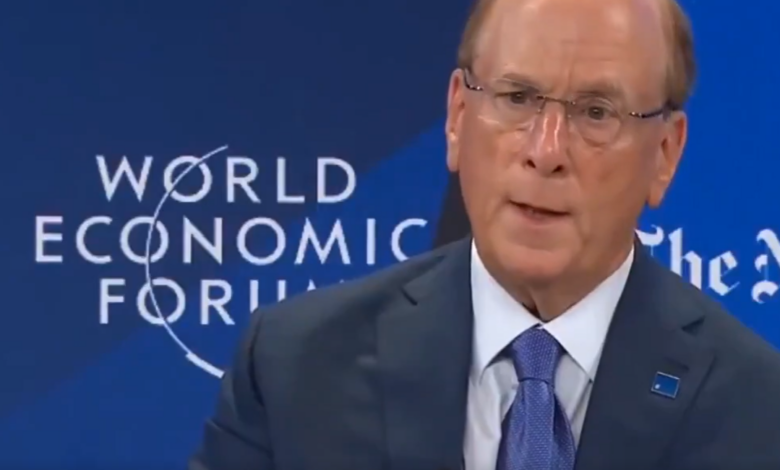
Exploring the Future of Tokenization: Insights from BlackRock’s CEO at the World Economic Forum
An Editorial Commitment to Quality and Transparency
Our editorial team is dedicated to providing meticulously researched, accurate, and unbiased content. We adhere to strict sourcing standards, ensuring each publication undergoes a thorough review by our skilled technology experts and experienced editors. This rigorous process guarantees that our readers receive valuable and relevant information.

Advertisement Banner
The Call for Blockchain Standardization by BlackRock CEO Larry Fink
During a pivotal address at the World Economic Forum, Larry Fink, the CEO of BlackRock, emphasized the urgent need to transition tokenization from experimental phases to becoming a fundamental part of financial infrastructure. He advocated for the establishment of a unified blockchain standard, which he argued could significantly lower costs and potentially mitigate corruption. This proposition has sparked a renewed debate within the cryptocurrency community, particularly among Ethereum supporters.
Why Ethereum Emerges as a Likely Candidate
While Fink did not specify a particular blockchain network, BlackRock’s existing involvement in on-chain products and research suggests Ethereum as a natural contender for the “one common blockchain” he envisions. His remarks were rooted in the practical advantages of digitized assets and interoperable settlement systems, rather than mere enthusiasm for cryptocurrency.
Advancements in Tokenization and Its Implications for Capital Markets
Fink pointed out the necessity of moving swiftly towards tokenization and decimalization, noting the progress made by Brazil and India in digital currency advancements. He extended his argument beyond payment systems to capital markets, asserting that tokenization could lead to reduced fees and greater democratization of investments, allowing seamless movement between various financial assets such as money market funds, equities, and bonds.
The Importance of Blockchain Standardization
Fink’s advocacy for a singular blockchain standard highlights a potential trade-off: increased dependency on one blockchain could enhance security and process efficiency. He posited that a unified blockchain could play a pivotal role in reducing corruption, presenting a compelling argument for standardization despite potential risks associated with relying on a single network.
The Strategic Role of Ethereum in BlackRock’s Tokenization Initiatives
In a broader context, the concept of “one common blockchain” aligns with BlackRock’s focus on Bitcoin and Ethereum in their public-market crypto offerings. Notably, BlackRock’s flagship exchange-traded funds (ETFs) include the iShares Bitcoin Trust (IBIT) and the iShares Ethereum Trust (ETHA), with ETHA launching in 2024 and becoming a central component of BlackRock’s Ethereum exposure.
Ethereum as the Default Network for BlackRock’s Tokenized Funds
BlackRock’s initial foray into tokenized funds with the BlackRock USD Institutional Digital Liquidity Fund (BUIDL), launched on Ethereum via Securitize in March 2024, underscores Ethereum’s significance as the original issuance network. Although BUIDL has expanded to multiple networks, Ethereum remains BlackRock’s preferred starting point for public-chain issuance, offering deep liquidity, extensive integration, and a conservative counterparty environment.
BlackRock’s Research Endorses Ethereum’s Infrastructure Potential
Recent insights from BlackRock’s 2026 thematic outlook further reinforce Ethereum’s potential as a foundational infrastructure layer for tokenization. The report suggests that Ethereum could serve as the “toll road” for tokenization, with stablecoin adoption acting as an early indicator of this trend. Notably, over 65% of tokenized assets currently reside on Ethereum, highlighting its dominance in the tokenized-asset landscape.
As of the latest market update, Ethereum (ETH) is trading at $3,005, reflecting its ongoing relevance in the cryptocurrency market.