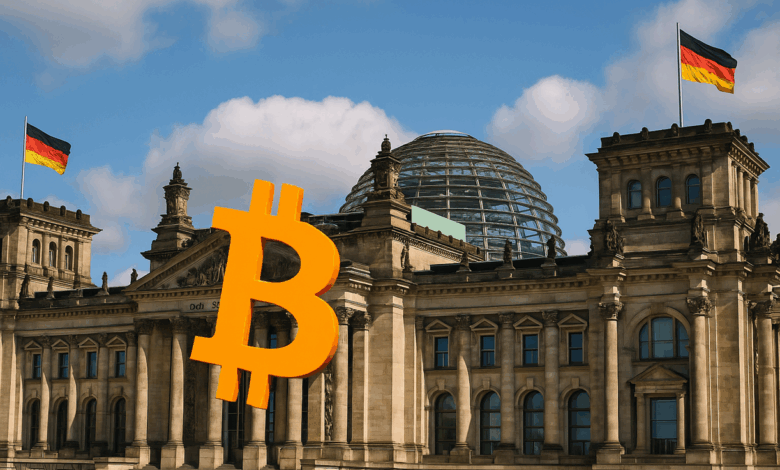
Germany’s Largest Opposition Party, AfD, Advocates for Bitcoin’s Strategic Role
Introduction to AfD’s Motion on Bitcoin
Germany’s prominent opposition party, the Alternative für Deutschland (AfD), has made a significant move by proposing a motion in the Bundestag that emphasizes Bitcoin as a vital technological advancement. The party urges Berlin to safeguard Bitcoin and its users from what it perceives as excessive governmental and EU oversight. This motion, titled “Recognizing the Strategic Potential of Bitcoin – Preserving Freedom through Restraint in Taxation and Regulation,” is spearheaded by MP Dirk Brandes and signed by the AfD parliamentary leadership.
Bitcoin’s Distinction from Other Crypto-Assets

Advertisement Banner
The AfD’s proposal distinctly separates Bitcoin from the wider category of “crypto-assets” as defined by the EU’s Markets in Crypto-Assets (MiCA) framework. The document asserts that “Bitcoin is a decentralized, non-manipulable, and limited-supply digital asset,” fundamentally distinguishing it through its technical architecture from other digital currencies. The motion cautions against applying MiCA’s regulatory norms to decentralized protocols like Bitcoin, arguing that such measures could stifle innovation and compromise digital autonomy, posing a threat to “financial freedom.”
AfD’s Pro-Bitcoin Stance in Germany
In terms of regulation, the AfD requests that the German federal government refrain from imposing licensing or registration mandates on non-custodial Bitcoin activities, explicitly referencing self-managed wallets, Lightning nodes, and associated infrastructure tools, provided that these do not involve custody of customer funds.
Focus on Taxation Policies
Tax policy is another critical aspect of the motion. It demands unambiguous legal protection for Germany’s existing one-year holding period, post which private gains from Bitcoin are tax-exempt. Additionally, the motion calls for a statutory differentiation between Bitcoin and other crypto-assets. The party further insists that Bitcoin mining and Lightning operations conducted for personal purposes should not be classified as commercial activities.
A Call for a Government Strategy on Bitcoin
Beyond regulatory and taxation considerations, the AfD advocates for a formal governmental strategy document addressing Bitcoin’s role as “free, digital money.” This strategy would explore the technological, energy, and monetary impacts of Bitcoin.
Criticism of the Digital Euro
The AfD has also criticized the European Central Bank’s “digital euro” initiative, promoting Bitcoin as an alternative that supports civil liberties. In a party release dated October 23, 2025, Dirk Brandes expressed that “Freedom begins with money… The digital euro is nothing more than a tool for surveillance and control – the opposite of freedom. Bitcoin, however, represents independence, property, and self-determination.”
The Future of Bitcoin in Germany’s Economic Landscape
The statement urges the government to recognize Bitcoin as a strategic technology of the future, suggesting the establishment of state Bitcoin reserves, facilitating pilot projects for BTC payments in the public sector, and eliminating tax discrimination against crypto-assets. Brandes concluded by asserting that “Germany must become an innovation leader in this field, not a surveillance state.”
Challenges and Political Context
Despite the bold statements, the official Bundestag motion is more moderate. It does not demand the immediate acquisition of sovereign Bitcoin reserves or the initiation of Bitcoin payments in the public sector. Instead, it proposes that Bitcoin be seen as “outside money”—a neutral global value base layer—considered for state reserve management amid monetary and geopolitical uncertainties. The motion emphasizes regulatory restraint, tax clarity, and the need for a comprehensive federal strategy.
AfD’s Position in German Politics
The political context adds significance to the motion. Since spring 2025, various national polls have shown AfD leading Germany’s political spectrum, surpassing major establishment parties. An April Ipsos survey placed AfD at 25%, ahead of the CDU/CSU at 24% and the SPD at 15%. While these are polling figures rather than electoral outcomes, they highlight why the AfD has amplified its libertarian and pro-sovereignty messaging, using Bitcoin as both a symbol of resistance to state control and a policy lever against establishment parties.
Institutional Challenges
Institutionally, the proposal faces significant hurdles. The AfD remains in opposition to the ruling grand coalition of CDU/CSU and SPD, led by Chancellor Friedrich Merz, confirmed by the Bundestag on May 6, 2025. Without committee majorities or procedural control, the AfD’s proposal is unlikely to advance to a vote in its current form. Nonetheless, some core elements—particularly legal certainty for the one-year tax exemption—may gain cross-party support during upcoming MiCA transposition discussions.
Conclusion
As of now, Bitcoin is trading at $113,164. The AfD’s motion underscores its commitment to positioning Bitcoin as a symbol of financial freedom and innovation, reflecting broader global discussions on the role of cryptocurrencies in modern economies.
“`