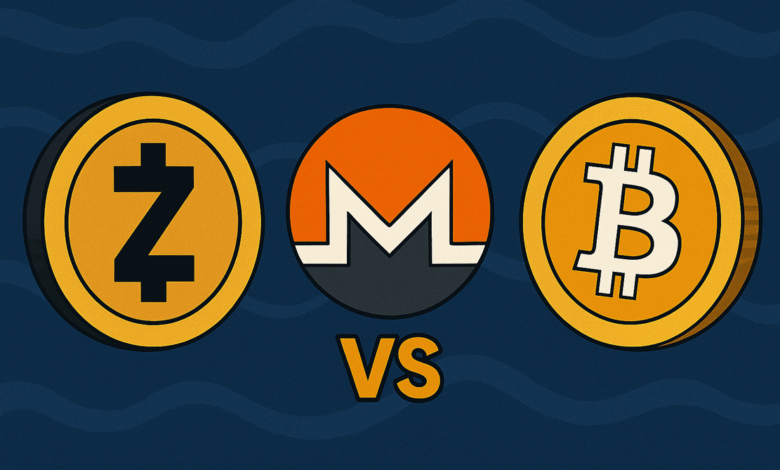
The Future of Privacy Coins: Zcash, Monero, and Bitcoin
Renowned MIT research scientist and Zcash co-founder, Madars Virza, has once again ignited discussions in the world of privacy-focused cryptocurrencies. His recent assertion emphasizes that Zcash’s shielded pool offers a markedly superior level of anonymity compared to Monero’s ring-signature approach. Furthermore, Virza highlights that Zcash could potentially outshine Bitcoin in a future dominated by quantum computing.
Reevaluating Privacy Recommendations in Cryptocurrency
In a recent update, Virza revisited the “conservative advice” from Bitcoin’s early days. Back then, the guidance was to allocate 1% of one’s net worth to Bitcoin. Today, however, he suggests encrypting at least 1% of one’s Bitcoin holdings to enhance transactional privacy. This paradigm shift from mere ownership to safeguarding privacy has sparked an in-depth technical debate on the efficacy of different privacy systems under contemporary scrutiny.

Advertisement Banner
Is Zcash Superior to Monero and Bitcoin?
When questioned on why Zcash might be preferable over Monero, Virza critiqued Monero’s ring-signature model. He argued that the fixed-size decoy sets in Monero create a smaller anonymity set that is more vulnerable to attacks. According to his analysis, each Monero transaction includes 16 decoys alongside the actual spend, but this number is insufficient to withstand generic attacks. Research has shown that due to biases in random distribution, the effective protection is closer to 4.2 decoys, making the true spender more identifiable than anticipated.
In contrast, Zcash’s fully shielded transactions eliminate the reliance on small, fixed rings. Each Zcash transaction draws from an anonymity set comprising all previous outputs in its shielded pool, significantly enhancing privacy. This is achieved through zero-knowledge proofs, ensuring transactions do not reveal which prior note is spent, thus expanding the anonymity set to potentially millions.
Virza also underscored another strategic advantage: Zcash’s integration with decentralized finance (DeFi) platforms. This integration facilitates deep liquidity for atomic swaps, allowing users to seamlessly move value in and out of the shielded pool. It also offers an opportunity to “encrypt” parts of their Bitcoin holdings through swap-based methods.
Zcash’s Edge in a Quantum World
Virza’s critique further delves into the realm of long-term security against quantum threats. He claims that Zcash offers post-quantum privacy, especially when using unique shielded addresses. Conversely, Monero’s reliance on discrete logarithms makes it susceptible to quantum computing advancements that could unravel transaction graphs by breaking key image logs.
Zcash’s Robust Privacy Model
The implications of this are profound. Monero’s anonymity hinges on mathematical properties that could be deciphered by future quantum computers, potentially exposing historical transaction links. In contrast, Zcash’s design inherently limits reconstructable metadata, reducing the risk of future quantum decryption.
Zcash engineer Sean Bowe elaborated on this point, emphasizing that Zcash’s privacy is due to the absence of sensitive data on-chain rather than mere obfuscation. He noted that even a millennium from now, no quantum computer or AI could retroactively unveil the identities of Zcash’s fully shielded transactions because such information never reaches the ledger.
However, Bowe cautioned that interactions at the boundaries of shielded and public systems, such as exchanges or wallets, might still leak information. Nonetheless, he asserted that starting with shielded Zcash transactions offers a robust baseline for privacy.
Market Performance of ZEC
As of the latest reports, ZEC has seen a remarkable surge, with a 52% increase in value, currently trading at $194.
Commitment to Quality Content
Editorial Process at Bitcoinist is dedicated to providing meticulously researched, accurate, and unbiased content. Adhering to strict sourcing standards, our team of leading technology experts and experienced editors ensure that each article undergoes thorough review. This rigorous process guarantees the integrity, relevance, and value of our content for our readers.