

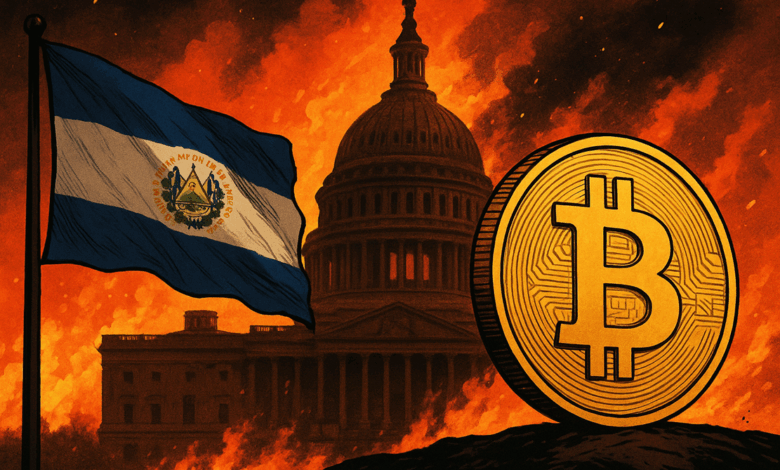
Senate Proposal Targets El Salvador’s Bitcoin Strategy and Leadership
Background of the Legislation
A group of Democratic Senators has put forward a legislative proposal that aims to scrutinize and potentially blacklist El Salvador’s President Nayib Bukele along with his inner circle. This proposed legislation, titled the El Salvador Accountability Act of 2025 (S. 2058), was filed on June 12 by Senators Chris Van Hollen (D-Md.), Tim Kaine (D-Va.), and Alex Padilla (D-Calif.). It is currently under consideration by the Senate Foreign Relations Committee.

Advertisement Banner
Focus on El Salvador’s Cryptocurrency Strategy
The proposed bill seeks to activate comprehensive economic sanctions under the International Emergency Economic Powers Act, targeting assets linked to thirteen Salvadoran officials, including President Bukele, Vice-President Félix Ulloa, and the head of the Central Reserve Bank. Additionally, the bill would nullify their visas. It also directs US representatives at global financial institutions like the World Bank and the International Monetary Fund (IMF) to vote against issuing new loans to El Salvador while simultaneously halting direct US financial aid.
Bitcoin as a Central Issue
A critical component of the legislation is Section 5, which mandates that the Secretary of State, in collaboration with the Treasury Department, submit an investigative report within 90 days. This report should detail the use of cryptocurrency by the Salvadoran government, including potential corruption, graft, and sanctions evasion involving Bitcoin. The report must include wallet addresses, transaction partners, and an estimation of the state’s Bitcoin reserves.
Historical Context and Human Rights Concerns
The current legislative effort echoes concerns initially raised in the bipartisan Accountability for Cryptocurrency in El Salvador (ACES) Act of 2022. This previous act required an assessment of the Bitcoin Law introduced by Bukele in 2021. Although Bitcoin’s status as legal tender was quietly rescinded in January as part of an IMF agreement, it continues to be accepted for payments and is held in the national treasury.
Human Rights and Economic Implications
The sponsors of the bill emphasize that the initiative is primarily a response to human rights violations. Senator Kaine pointed out that many Salvadorans and some US residents have been detained in large prisons without due process under Bukele’s leadership. Senator Van Hollen criticized Bukele for using American taxpayer money to infringe on constitutional rights, while Senator Padilla described the situation as “abhorrent” and advocated for economic sanctions as a necessary response.
Broader Economic and Political Concerns
The Bitcoin-related provisions of the bill reflect Washington’s apprehension regarding the potential for El Salvador’s economy to become a hub for sanction evasion, especially if US regulatory oversight were to be relaxed. The proposed legislation would require the State and Treasury Departments to disclose details about El Salvador’s Bitcoin holdings, including wallet addresses and custodial arrangements.
President Bukele’s Reaction
In reaction to the proposed legislation, President Bukele, known for his active presence on social media, dismissed the initiative with ridicule on X (formerly Twitter), suggesting that the Democrats are merely frustrated.
Legislative Process and Future Implications
Should the bill advance, it grants any committee member the power to bring it to the Senate floor if the State Department fails to provide the required reports. While the sponsors are prepared to leverage this procedural option, the bill’s future remains uncertain given the lack of clear Republican support and the open stance of the House of Representatives.
Potential Outcomes
If enacted, the White House would be obligated to list sanctioned individuals within ten days and deliver the comprehensive report within 90 days. These sanctions would remain in place for a minimum of four years unless the President certifies that El Salvador has ended its practice of mass detentions and ceased any Bitcoin-related sanction evasion activities.
Editorial Standards
Editorial Process
Our editorial team is committed to delivering thoroughly researched, accurate, and impartial content. Each publication undergoes rigorous scrutiny by our team of technology experts and experienced editors to ensure the highest standards of integrity, relevance, and value for our readers.