
World Economic Outlook: Challenges and Opportunities
Our editorial content is meticulously curated and reviewed by industry experts and experienced editors, ensuring a high standard of accuracy and reliability. This article may contain affiliate links. Ad Disclosure
Grim Forecast for Global Economic Growth
The World Bank has issued a stark prognosis for the world economy, projecting a growth rate of merely 2.3% for the upcoming year. This figure represents a decline from the previously anticipated 2.7% growth in 2024, marking it as the weakest performance outside of recessions over the past 17 years. Unfortunately, these diminished growth rates are not evenly distributed, with numerous developing economies teetering on the brink of recession.

Advertisement Banner
Cryptocurrency: A Beacon Amidst Economic Gloom
Despite the bleak economic forecast, the cryptocurrency market, particularly Bitcoin, continues to show resilience. Bitcoin is on track to potentially rival gold’s substantial market capitalization, positioning itself as a cornerstone of the future global economy.
Trade and Tariffs: Key Contributors to Economic Slowdown
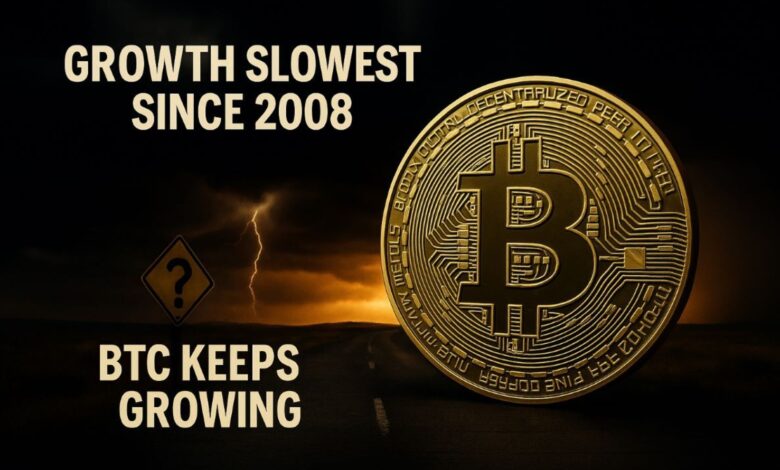
The World Bank’s June 2025 report presents a sobering analysis of global growth, which has decelerated to 2.3%, marking the weakest non-recessionary year since 2008. This slowdown is attributed primarily to trade tensions and tariffs.
Impact of Tariffs on Global Trade
Persistent trade disputes, especially those involving tariffs, have significantly hindered global trade growth. Historical data illustrates this decline:
- 5.1% in the 2000s
- 4.6% in the 2010s
- 2.6% in the 2020s
The imposition of tariffs, notably by the United States, has exacerbated trade discord, resulting in projected trade volume growth of a mere 1.8%, less than half the pre-pandemic average. Tariffs act as formidable barriers to trade, amplifying geopolitical risks and deterring investment, thereby undermining private sector confidence globally.
Major Economies Feeling the Pinch
Even robust economies have not been immune to the slowdown. The United States, with a projected growth rate of 1.4%, and the Eurozone, with expectations of 0.9%–1.2%, are rapidly losing momentum. The World Bank warns of a prolonged economic slump unless there is a concerted effort to address trade conflicts and implement coordinated policy responses.
Developing Economies: The Hardest Hit
Emerging markets are suffering disproportionately from the global economic downturn:
- Almost two-thirds of these economies are growing below their decade-long average.
- In many regions, per capita income growth is failing to keep pace with population increases.
Africa and Latin America face formidable challenges, including debt crises, sluggish investment, and inflationary pressures, even as their populations are poised for significant growth. For instance, sub-Saharan Africa is projected to experience a nearly 20% population increase by the end of the decade. The report warns that over half of low-income countries are at high risk of debt distress, complicating the path to economic recovery.
Capital Flight and Structural Challenges
Higher interest rates in developed economies have siphoned capital away from emerging markets, exacerbating their economic struggles. Without structural reforms, infrastructure investments, and improved access to capital markets, these economies risk becoming ensnared in low-growth traps, thereby weakening the influence of strong economies on global economic prospects.
Bitcoin’s Role in Economic Uncertainty
Traditionally regarded as a safe haven asset, gold continues to attract investors during periods of economic uncertainty, experiencing an 18% year-on-year price increase. However, Bitcoin has emerged as a formidable competitor, with its market capitalization soaring to approximately $2.08 trillion, though still only a fraction of gold’s $23 trillion market cap.
Institutional Adoption of Cryptocurrency
Institutional interest in cryptocurrencies is on the rise, with financial advisors increasingly incorporating crypto products into their portfolios. The success of Bitcoin ETFs, which have garnered over $40 billion in net inflows since their inception, underscores the growing intersection of traditional finance and cryptocurrency.
Preparing for Economic Shifts with Bitcoin
While Bitcoin alone cannot reverse global economic trends, it serves as a critical hedge against slow growth and systemic risks. Its role as a store-of-value asset, alongside gold, positions it as a key player in the next financial cycle.
Embracing the Crypto Economy with the Best Wallet
To navigate the evolving economic landscape, having a reliable Web3 crypto wallet is essential. The Best Wallet token ($BEST) and its app offer a user-friendly, secure solution, equipped with features like biometric security, multi-wallet ecosystems, and the upcoming Best Card for seamless crypto transactions.
The non-custodial crypto wallet market has expanded to $11 billion, with Best Wallet poised to capture a significant share. The ongoing presale has raised $13.3 million, with tokens priced at $0.025175, and projections suggest $BEST could reach $0.072 by year-end—a remarkable 185% increase.
Bitcoin’s Potential to Counter Global Recession
While Bitcoin cannot single-handedly prevent a global recession, its growing role as a hedge against economic instability is undeniable. As central banks face limitations in stimulating economies due to high debt and persistent inflation, Bitcoin and other cryptocurrencies offer an alternative avenue for investors seeking stability outside the traditional financial system.
In conclusion, while this article does not constitute financial advice, exploring the potential of cryptocurrencies and securing a reliable crypto wallet could be prudent steps in navigating the uncertain economic future.
Commitment to Editorial Integrity
Our editorial process at Bitcoinist is dedicated to providing thoroughly researched, accurate, and unbiased content. We adhere to strict sourcing standards, with each page undergoing rigorous review by our team of top technology experts and seasoned editors. This ensures the integrity, relevance, and value of our content for our readers.