

The Future of Bitcoin ETFs: A Potential Revolution in the Financial World
Introduction
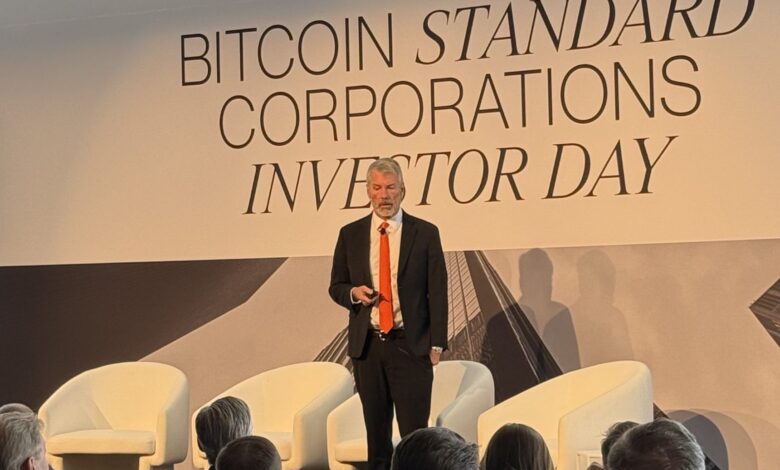
In the ever-evolving landscape of exchange-traded funds (ETFs), a bold prediction by Michael Saylor, executive chairman of MicroStrategy, has captured significant attention. Speaking at Bitwise’s Bitcoin Standard Corporations Investors Day, Saylor asserted that BlackRock’s iShares Bitcoin Trust (IBIT) could become the world’s largest ETF within a decade. This ambitious claim has stirred discussions among financial experts and industry leaders, as it challenges the dominance of traditional broad-based equity funds.

Advertisement Banner
The Current Position of IBIT
Presently, BlackRock’s iShares Bitcoin Trust holds a prestigious position in the realm of digital assets. As reported by Bitcoin Treasuries, IBIT manages over 575,000 BTC, translating to approximately $54.3 billion. This remarkable asset collection positions it as one of the most successful ETF launches in history, setting the stage for its potential ascent to the top.
Can Bitcoin Propel BlackRock’s ETF to the Top?
Despite the optimism surrounding Saylor’s prediction, skepticism abounds, fueled by data-driven analyses. Nate Geraci, president of The ETF Store and host of ETF Prime, highlighted the significant gap IBIT needs to bridge to surpass the current leader, the Vanguard S&P 500 ETF (VOO). With VOO amassing over $51 billion in net inflows in 2025 alone, matching IBIT’s entire asset base, the challenge appears monumental.
The Challenge of Surpassing VOO
Adding to the conversation, Eric Balchunas, a senior ETF analyst at Bloomberg, offered a cautious perspective. While acknowledging IBIT’s record-breaking debut, he emphasized the entrenched dominance and consistent cash flow of VOO, which is 10 times larger and attracts five times more daily cash. For IBIT to organically close this gap, Balchunas suggested it would require inflows exceeding $1 billion per day, possibly reaching $3 to $4 billion daily.
Market Conditions and Potential Growth
For IBIT to achieve such growth, extraordinary market conditions would need to prevail. Balchunas pointed out that a significant shift in investor sentiment, driven by the narrative of Bitcoin as a “perfect savings” vehicle, could play a crucial role. However, he emphasized that the gravitational pull of cash flow from dividends and earnings remains a powerful force in portfolio construction.
Saylor and Fink’s Vision for Bitcoin
Michael Saylor’s projection aligns with the broader market environment influenced by BlackRock CEO Larry Fink’s bullish Bitcoin outlook. During a panel at the World Economic Forum in Davos, Fink suggested that substantial institutional allocations, even as small as 2% to 5%, could propel Bitcoin’s value to unprecedented heights—potentially reaching $500,000 to $700,000 per Bitcoin.
Bitcoin as a Hedge Against Economic Instability
Fink described Bitcoin as a “currency of fear,” emphasizing its borderless nature as a hedge against currency debasement and geopolitical instability. For Saylor, whose corporate-treasury Bitcoin strategy mirrors this perspective, Fink’s insights provide macro-level validation. Should sovereign wealth funds act on exploratory discussions, the demand for Bitcoin could outpace the finite supply within IBIT.
Conclusion
The future of BlackRock’s iShares Bitcoin Trust hinges on its ability to attract substantial investment, outpacing the steadfast inflows into traditional equity funds. As global investors remain drawn to cash-generative assets, the question remains whether Bitcoin can redefine the financial landscape, ushering in a new era for ETFs.
Editorial Standards
Our Editorial Process is committed to delivering meticulously researched, accurate, and unbiased content. We adhere to stringent sourcing standards, ensuring each article undergoes thorough review by top technology experts and seasoned editors. This rigorous process maintains the integrity and value of our content for our audience, providing insights that resonate with industry trends and advancements.